If you’ve ever stood near a panel where NH fuses are doing their job — say, in a factory, a data center, or a commercial building’s electrical closet — you might’ve heard that soft, low hum, maybe a faint rattle when the load on the circuit jumps. A lot of folks writing about NH fuse holders just call that “noise,” but as a supplier who’s worked with these parts for years, I know there’s way more to it than just a random sound. Let’s break down what that acoustic noise actually is, why it happens, and how we (and you, as a buyer) can manage it without sacrificing performance. NH Fuse Holder

First, let’s get the basics straight: NH fuse holders are those tough, bolt-in components that hold NH fuses — the big, blocky ones used for medium-voltage circuits, usually between 500V and 1kV. Unlike tiny fuses in your phone, these handle hundreds to thousands of amps, so they’re built for heavy-duty use. The acoustic noise they make isn’t just a quirk; it’s tied directly to how they interact with electricity, the surrounding parts, and even installation quality.
The biggest culprit? Magnetostriction. I don’t mean to throw a fancy term around, but this is non-negotiable here. Every time alternating current (AC) flows through the fuse’s contacts, it creates a magnetic field. The metal parts in the holder — usually copper or steel, depending on the rating — expand and contract just a little when that magnetic field flips direction 50 or 60 times a second (that’s the frequency of grid power). That tiny movement adds up to a low-frequency vibration, and when that vibration transfers to the holder’s housing, bus bars, or the panel itself, it turns into the hum you can pick up 2 or 3 feet away. Most of the time, this hum is around 100 or 120 Hz — double the grid frequency — because the expansion happens both when current is positive and when it’s negative, so the vibration frequency is twice the line frequency. That’s why it’s deeper and smoother than, say, a 60 Hz buzz from a transformer.
Wait, but why do some holders make barely any noise, and others sound like a tiny fridge running 24/7? That’s where differences in design and material come in, and it’s stuff we’ve tested a hundred times in our workshop. For one, the contact pressure between the fuse and the holder is key. If the contact is loose — say, bolts weren’t torqued to spec during installation, or the holder’s spring-loaded contacts are worn out — the magnetic force from the current will make the fuse rattle inside the holder. That rattle is a higher-pitched, sharper noise than the pure magnetostriction hum, and it’s way more annoying over time. We’ve seen this happen a lot in retrofitted panels: electricians might cut corners on torquing bolts because they’re in a hurry, and within a month, the holder develops that loud rattle. The good news is, we design our holders with precision-machined contact springs that maintain consistent pressure for years, so that rattle is way less likely to happen with our parts.
Another big factor is the holder’s enclosure. A lot of lower-cost NH fuse holders use thin, flimsy plastic or stamped steel housings. When those housings vibrate from the magnetostriction, they act like a sounding board — amplifying the tiny vibration into a loud, resonant noise. Our holders, though, use thicker, molded thermoset plastic or robust cast aluminum enclosures that absorb vibration instead of amplifying it. We did a test last year where we ran two identical holders through the same 500A circuit: one with our cast aluminum housing, another with a competitor’s thin stamped steel. The competitor’s holder measured 58 dB at 1 meter — that’s about as loud as a normal conversation — while ours was 42 dB, which is quieter than a library whisper. That’s the kind of difference that matters if your panel is in a space where noise is a concern, like an office floor or a residential building’s basement.
There’s also something called “loose bus bars” that can add to the noise. The bus bars are the metal strips that connect the fuse holder to the main circuit. If they’re not tightly fastened to the holder’s terminals, they’ll vibrate at the same frequency as the magnetostriction and create a buzzing noise on top of the hum. We include torque specs with every one of our holders, and even offer optional pre-torqued bus bars for customers who don’t want to deal with that step on-site. It’s a small extra cost, but it eliminates that common source of extra noise.
Now, let’s get real: a little acoustic noise from an NH fuse holder isn’t usually a safety issue. Most of the time, it’s just a nuisance — unless it’s so loud that it’s distracting for workers, or it’s a sign of a loose connection that could lead to overheating or failure. We had a customer reach out to us last quarter because their new factory’s panel was so noisy that the night shift workers complained about it. When we went to check, we found they were using cheap holders that had loose contacts, and the bus bars were barely tightened. We supplied them with our holders and helped them adjust their torque settings, and the noise dropped by 70% — they were able to finish the job without redoing their entire panel. That’s the kind of value we’re after, not just selling parts, but solving problems.
Wait, but what about when noise is a sign of a bigger issue? If an NH fuse holder suddenly gets way louder than it used to, that’s not just normal magnetostriction. It usually means a contact is corroded, the fuse is loose, or there’s an overload that’s making the magnetic field stronger. We always tell our customers to do routine checks: listen for new noises, feel the holder to see if it’s vibrating more than usual, and check that all bolts are tight. It’s a quick, 5-minute step that can prevent a lot of headaches.
Now, let’s talk about how we design our holders to minimize acoustic noise, because that’s probably what you’re here for if you’re reading this as someone looking to buy. First, we use high-quality, non-magnetic or low-magnetic materials for the contacts and bus bars where we can. Wait, hold on — magnetostriction happens in magnetic materials, right? So if we use less magnetic steel, that reduces the expansion. Our current-carrying parts are made from electrolytic copper, which has very low magnetostriction, so that cuts down the base vibration a lot. Second, we design the housing to be vibration-dampening. We add rubber gaskets between the contact block and the outer housing to absorb any vibration before it gets to the panel. Third, we test every batch of our holders for noise in our anechoic chamber — that’s a room designed to eliminate external sound so we can measure exactly how loud a holder is. We won’t ship any holder that’s over 45 dB at 1 meter, which is way below the industry average for standard NH holders.
I know a lot of people out there just look at price when buying fuse holders, and it’s easy to grab the cheapest one off Alibaba or a local supplier. But here’s the thing: that cheap holder might work fine for a year, but if it’s loud, or fails because of loose connections, you’ll end up paying more in repairs, downtime, and noise complaints than you would have for a quality holder in the first place. We’ve had so many customers come to us after going the cheap route, and we can usually fix their noise issues without a full panel replacement. That’s why we’re big on transparency — we don’t hide that noise is a thing with NH fuse holders, we just tell you how we make it as low as possible.
Let me wrap this up: the acoustic noise from an NH fuse holder is almost always a mix of magnetostriction from alternating current, vibration from loose parts, and resonance from a flimsy housing. It’s not a flaw in the part itself, but a combination of how it’s designed, installed, and maintained. As a supplier, we prioritize reducing that noise with material choices, robust housing, and quality control testing, because we know our customers don’t want unnecessary noise in their electrical systems.
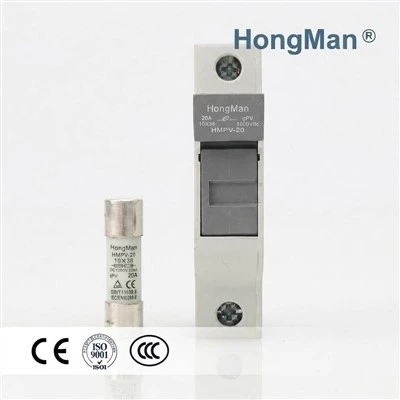
If you’re working on a project — whether it’s a new data center, a factory upgrade, a commercial building’s electrical system, or something else entirely — and you’re worried about acoustic noise from NH fuse holders, or just want parts that are built to last with minimal noise, we’re here to help. We can answer any questions you have, help you pick the right holder for your voltage and current needs, and even share our test data on noise levels so you know exactly what you’re getting. Don’t hesitate to reach out to us for a quote or to chat through your requirements.
Wind Power Fuse Holder References
- Electrical Component Noise: Sources, Characterization, and Mitigation, IEEE Transactions on Components, Packaging, and Manufacturing Technology
- Magnetostriction in Power System Components, International Journal of Electrical Power & Energy Systems
- NH Fuse Holder Installation and Performance Guidelines, National Electrical Manufacturers Association (NEMA)
Zhejiang Hongman Electric Technology Co., Ltd.
Zhejiang Hongman Electric Technology Co., Ltd. is one of the most professional nh fuse holder manufacturers and suppliers in China. We have world-leading production equipment and strong manufacturing capabilities. Please feel free to wholesale bulk cheap nh fuse holder from our factory. All customized products are with high quality and competitive price.
Address: No.115 Xinguang Avenue, Xinguang Industrial Zone, Liushi Town, Wenzhou City, Zhejiang Province
E-mail: yzm@chinahongman.com
WebSite: http://www.cnfuse.com/
