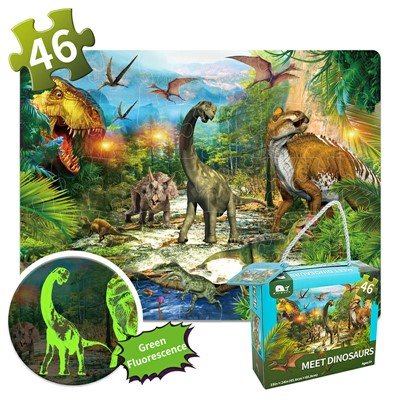
When it comes to selecting educational puzzles for 3 – year – olds, one of the most common questions parents and educators ask is: "How many pieces should an educational puzzle for a 3 – year – old have?" As a supplier of educational puzzles, I’ve encountered this query countless times. In this blog post, I’ll share insights based on child development theories, market trends, and practical experience to help you make an informed decision. Educational Puzzles
Developmental Abilities of 3 – Year – Olds
At the age of 3, children are in a crucial stage of cognitive, motor, and social – emotional development. Cognitively, they are beginning to understand basic concepts such as shapes, colors, and spatial relationships. Motor skills are also evolving; their fine motor skills, which involve the small muscles in their hands and fingers, are becoming more refined, allowing them to pick up small objects and manipulate them with increasing dexterity.
From a cognitive perspective, 3 – year – olds are starting to think symbolically. They can understand that a puzzle piece represents a part of a whole image. However, their attention spans are still relatively short, usually ranging from 15 to 20 minutes for focused activities. This means that puzzles should not be overly complex or time – consuming to complete.
In terms of motor skills, 3 – year – olds are typically able to hold and turn puzzle pieces. But they may still struggle with precise alignment and fitting pieces together. Therefore, puzzles need to be designed in a way that accommodates their current skill level while also providing opportunities for growth.
Ideal Number of Puzzle Pieces
Based on the developmental characteristics of 3 – year – olds, puzzles with 10 to 20 pieces are generally considered ideal. Puzzles in this range strike a good balance between being challenging enough to engage the child’s mind and not so difficult that they become frustrated.
A 10 – piece puzzle is often a great starting point for 3 – year – olds who are new to puzzles. These puzzles usually have larger pieces, which are easier for small hands to grasp. The limited number of pieces also makes the task of completing the puzzle more manageable. With a 10 – piece puzzle, a child can start to understand the concept of fitting pieces together and matching shapes and colors.
As the child becomes more proficient with puzzles, puzzles with 15 to 20 pieces can be introduced. These puzzles offer a bit more of a challenge, requiring the child to pay closer attention to details and use more problem – solving skills. For example, they may need to rotate puzzle pieces to find the right fit or figure out how different sections of the image connect.
Benefits of the Right Number of Pieces
Puzzles with an appropriate number of pieces offer several benefits for 3 – year – olds. Firstly, they enhance cognitive development. As children try to fit the pieces together, they are practicing spatial reasoning, which is the ability to understand how objects fit in space relative to each other. This skill is essential for later academic success, especially in subjects like mathematics and science.
Secondly, puzzles improve fine motor skills. Manipulating the puzzle pieces helps strengthen the muscles in the hands and fingers, which is important for tasks such as writing and drawing. The more the child practices handling the pieces, the more precise their movements become.
Thirdly, puzzles can boost a child’s self – esteem. When a 3 – year – old successfully completes a puzzle, they feel a sense of accomplishment. This positive experience encourages them to take on new challenges and builds their confidence in their abilities.
Considerations for Puzzle Selection
While the number of pieces is an important factor, there are other aspects to consider when selecting an educational puzzle for a 3 – year – old.
Theme and Design
The theme of the puzzle should be appealing to 3 – year – olds. Popular themes include animals, cartoon characters, and simple landscapes. The colors should be bright and vivid to attract the child’s attention. Additionally, the design of the puzzle should be simple and easy to understand. Avoid puzzles with overly detailed or complex images that may overwhelm the child.
Quality
High – quality puzzles are essential for young children. The pieces should be made of durable materials that can withstand being dropped, chewed on (as 3 – year – olds often explore objects with their mouths), and handled repeatedly. The edges of the pieces should be smooth to prevent any injuries.
Safety
Safety is of utmost importance when it comes to toys for young children. Puzzles should be free from small parts that could be a choking hazard. They should also be made from non – toxic materials to ensure the child’s well – being.
Market Trends
In the market for educational puzzles, there has been a growing demand for puzzles specifically designed for 3 – year – olds. Manufacturers are increasingly focusing on creating puzzles that are not only educational but also fun and engaging. Some puzzles come with additional features, such as built – in sound effects or interactive elements, to make the puzzle – solving experience more enjoyable.
There has also been a trend towards puzzles that align with early childhood education curriculums. For example, puzzles may be designed to teach specific concepts such as counting, letter recognition, or basic shapes. As a supplier, we keep a close eye on these market trends to ensure that our products meet the evolving needs of parents and educators.
Our Product Offerings
At our company, we offer a wide range of educational puzzles for 3 – year – olds. Our puzzles are carefully designed to have the ideal number of pieces, usually between 10 and 20. We offer a variety of themes, from cute animals to popular children’s stories, to ensure that there is something to appeal to every child.
All of our puzzles are made from high – quality, non – toxic materials. The pieces are large enough for small hands to handle easily, and the edges are smooth and safe. We also pay attention to the design of our puzzles, making sure that the images are clear and simple enough for 3 – year – olds to understand.
Conclusion
Selecting the right educational puzzle for a 3 – year – old involves considering the number of pieces, as well as other factors such as theme, quality, and safety. Puzzles with 10 to 20 pieces are generally the best choice for this age group, as they provide an appropriate level of challenge while also being accessible to young children.
Jigsaw Puzzles If you’re a parent, educator, or retailer looking for high – quality educational puzzles for 3 – year – olds, we’d love to hear from you. Contact us to discuss your purchasing needs and explore our range of products. We’re committed to providing the best educational puzzles to help children learn and grow.
References
- Berk, L. E. (2018). Infants, Children, and Adolescents. Pearson.
- Fisher, K. W., & Bidell, T. R. (2006). Dynamic development of cognitive structures in action and thought. In W. Damon & R. M. Lerner (Eds.), Handbook of child psychology: Vol. 1. Theoretical models of human development (6th ed., pp. 313 – 399). Wiley.
- National Association for the Education of Young Children (NAEYC). (2019). Developmentally appropriate practice in early childhood programs serving children from birth through age 8. NAEYC.
NINGBO LOTO PACKAGE MANUFACTORY CO.,LTD
Ningbo Sentu Art and Crafts Co., Ltd. is one of the most professional educational puzzles manufacturers and suppliers in China. With abundant experience, we warmly welcome you to buy high quality educational puzzles made in China here from our factory. If you have any enquiry about cooperation, please feel free to email us.
Address: 3rd Floor, Momi Community, New Jinfeng, No. 68, Chunchao Road, Yinzhou District, Ningbo City, Zhejiang Province, Ningbo, Zhejiang, China
E-mail: sales@nbprinting.com
WebSite: https://www.lotopuzzle.net/
